

From Mexico to Texas, student-athlete Lucia Hidalgo is using her experiences in elite tennis, leadership, and advocacy to create spaces where athletes feel seen, supported, and empowered beyond performance.
At just 16 years old, Lucia Hidalgo is already creating impact well beyond the tennis court. Originally from Mexico and now a junior in Texas, Lucia has built an impressive athletic journey that includes training at IMG Academy, competing at a high level in tennis, coaching younger athletes, and dedicating her time to community service.
Her experiences as a student-athlete inspired her to launch Beyond the Game, a mental health initiative focused on supporting athletes beyond performance. Lucia also serves as a Morgan’s Message ambassador and is a member of the Athletes for Hope High School Leadership Academy (HSLA), where she continues to grow as a leader and changemaker.
In this Q&A, Lucia reflects on her move to the United States, how service became a source of connection and purpose, and why creating supportive spaces for student-athletes matters both on and off the court.
1. You moved to the United States from Mexico and jumped right into volunteering
and community work. How did the transition shape your awareness of mental
health – especially as a student-athlete navigating a new country and culture?
Moving from Mexico to the United States at such a young age was a significant transition for my family
and me, both socially and athletically. I had to learn a new language, adjust to a new school system, and
integrate socially, all while continuing to train and work on my tennis. However, I think the move also
allowed me to see all the different social issues, as well as the mental health struggles that went on in both
countries, and making the move made me more aware of how important support systems are.
Seeing first hand how isolating things can feel, especially for student-athletes who are already under
tremendous pressure, invited me to start participating in all kinds of community/service projects.
Volunteering and getting involved in destigmatizing mental health helped me build lifelong connections
and gave me a sense of purpose outside of just tennis.
This change really opened my eyes to the importance of mental health, making me more empathetic and
motivating me to start conversations around mental health, because I know how impactful it is to be seen
and supported during difficult times or changes in life.
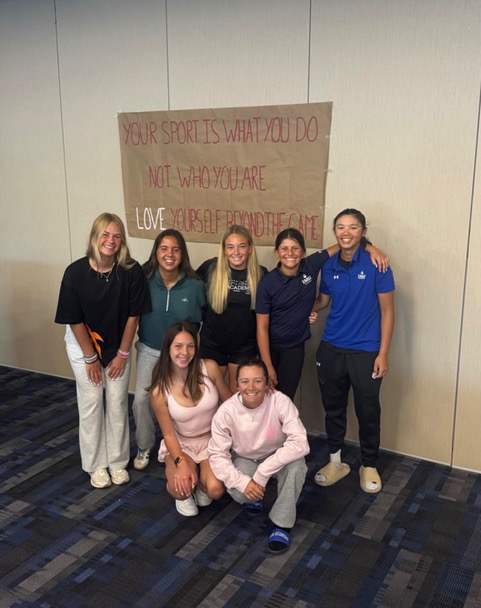
2. Can you walk us through Beyond the Game and what it means to you personally?
What inspired you to start this program, and how does its mission connect to your
own experiences as a student-athlete?
Beyond the game is a mental health initiative I started in order to create a space where student-athletes
feel seen, heard, and valued beyond their performance. It mainly focuses on breaking the stigma around
mental health and encouraging athletes, parents, and coaches to have honest conversations about the
pressure and struggles athletes face.
For me, it is extremely personal. During my time training at IMG Academy, I was in a very intense and
competitive training environment where performance and results were constantly on my mind. While this
was a life-changing opportunity that helped me grow as an athlete and person, it was also mentally and
emotionally challenging. There were many instances when I felt extreme pressure to constantly perform
and improve, and I struggled to balance that drive to improve with my own well-being. The fear of being
misunderstood for my mental health struggles many times also kept me quiet, and it wasn’t until I had a
coach who really took the time to make sure I understood that it’s okay not to be okay that I decided to
make the change.
That experience made me realize how common it is for athletes to silently be their own worst enemy, both
on and off the field. The mission is to shift the culture in sports so that mental and physical health are both
given importance and understanding. It is about building a community where honesty is seen as a
strength, not a weakness, and where athletes feel supported as people, not just performers.
3.What has been the most impactful moment or conversation in your mental health
work with Beyond the Game so far?
One of the most impactful conversations I’ve had during the timeline of Beyond the Game was actually
before it even started. I had gone through the entire first semester being mentally exhausted and one day I
finally snapped. After practice, one of my coaches noticed that I was having a hard time and took the
opportunity to sit with me at the edge of the court for a long conversation.
We talked for hours, where she shared parts of her own story and reminded me the importance of coaches,
support systems, and being open about what you are going through. At one point, we were literally
writing things down on the ground about what I was feeling and struggling with, just trying to make sense
of everything I had been holding in.
In that moment, for the first time ever, I felt truly seen. Not just as an athlete, but as a person. That
conversation stayed with me and made me realize how powerful it is when someone takes the time to
truly listen. It was also the moment I understood that I wanted to help other athletes feel that sense of
support as well.
From that experience, Beyond the Game really started to take shape. The way my coach showed up for
me changed something in me and made me want to do the same for others.
4. As a member of the Athletes for Hope High School Leadership Academy, what does
leadership in the mental health space look like at the high school level? What unique
challenges and opportunities do you see as a student trying to shift the culture
around wellbeing in your school?
Being a part of Athletes for Hope High School Leadership Academy has helped me understand that
leadership in any space of advocacy doesn’t always look like big speeches or large programs. At the High
School level, it often starts with small, consistent actions. For example, checking in on teammates,
normalizing conversations about stress, and creating an open and welcoming environment.
One of the biggest challenges as a student-athlete is that there is still a strong culture about “pushing
through everything”, especially in sports. It is common for athletes to feel like they have to hide their
struggles in order to seem strong or dialed in. It can be difficult to shift that mindset, especially when
performance is at the forefront of everything.
At the same time, the AFH leadership academy allowed me to see a lot of opportunities for high school
athletes. High school is where habits and mindsets are formed, so even the smallest of changes in how we
talk, act, or feel about mental health can have a lasting impact. As an AFH athlete, I am in a unique
position to influence my peers and then allow them to do the same. Leadership, to me, is about leading by
example, being open, being as supportive as possible, and being consistent in how I try to show up for
others.

5.You spent two years at IMG Academy in Florida, training at one of the highest
levels of junior tennis, away from your family in Texas, facing intense competition
and demanding coaches. What was that experience like mentally and emotionally,
and how did navigating that pressure shape the way you now think about athlete
mental health?
My time at IMG was one of the best but also most challenging experiences of my life, both mentally and
physically. Being away from my family, while training at such high intensity, pushed me in ways I never
thought I would be ready for.
Every day, I was surrounded by elite athletes, constant competition, and extremely high expectations from
my coaches, my family, and especially myself. While this way of life helped me grow a lot as a player, it
also made it easy to tie my self-worth to my performance. There were many times when I felt mentally
drained, overwhelmed, and not enough, both as an athlete and as a person. Being so new to this feeling,
there were times I struggled to balance my ambitions with self-care as well, and I didn’t know how to
process what I was feeling.
But going through those challenges ultimately changed the way I see athletes and their mental health. It
made me realize that even the most successful and “perfect” athletes can be struggling internally. It also
showed me how important it is to have someone who truly listens, and how to become that someone for
others.
Now I view mental health as just as important as physical training. My time at IMG is a big part of why I
am so passionate about changing the culture in sports, so athletes at all levels can feel supported not just
for their outcomes, but for them as a person.
6. How do you personally protect your own mental health and avoid burnout while
giving so much of yourself to others?
Protecting my mental health is something that I have had to learn to do intentionally, especially while
balancing so many commitments. One of the biggest things I’ve realized is that I can’t pour myself into
others if I feel completely drained. Which is why taking care of my own well-being has to be a priority,
not an afterthought.
I try to stay aware of when I start to feel overwhelmed and give myself space to breathe, take a break, and
spend time with people who support me. I’ve also learned the importance of setting boundaries, because it
is especially when someone is going through a hard time that it is easy to lose oneself.

7. Mental health conversations can look very different across cultures. As someone
who is bilingual and bicultural, what do you think the sports and wellness
communities in the U.S. can learn from how mental health is discussed (or not
discussed) in Latin American cultures?
Being bilingual and bicultural has allowed me to see different perspectives on mental health. In many
Latin American cultures, mental health is often kept in and not openly discussed. There can be a tendency
to push through struggles, keep things in, and avoid recognizing them.
At the same time, I think there is something really valuable about the Latin American culture, which is
family and community. Throughout my life, I have never felt a lack of support, and that is thanks to the
second family I have formed both in Texas and Mexico; the only thing missing at times was the courage
to tell them how I feel.
In the US, I’ve seen more openness and willingness to talk about mental health, especially in sports,
which is incredibly important. But I think there is still a lot to learn in both places.
Being in both worlds has shown me that the goal is not to choose one approach over the other, but to try
and combine them both. Creating a culture where athletes feel supported by their community and
comfortable speaking about what they are going through.
8. What’s one thing you wish every student-athlete knew about mental health…
something you would want to carry forward as your legacy?
One thing that I wish every student athlete knew is that their value is not defined by their performance. It
is easy to believe that your skills, your rankings, or how you play in a game determine who you are, but it
doesn’t.
Mental health is just as important as taking care of your body, and taking care of it doesn’t make you
weaker; it actually makes you stronger in the long run. It is more than okay to struggle, it is okay to ask
for help, and it is normal not to have everything figured out.
If there is one thing I hope to leave behind as my “legacy,” it is a shift in mindset. I want athletes to feel
like they can change, like they can be open, support each other, and know that they are more than their
sport. Because at the end of the day, who you are as a person will always matter more than any result.