
Student-Athlete Mental Health Week 2026 brought together more than 572 schools in all 50 states. It was Athletes for Hope’s first year as co-presenting partner with Hilinski’s Hope, and the movement has never been bigger.
This was the year the movement got bigger
In 2018, Washington State quarterback Tyler Hilinski died by suicide. He was 21, and he had been suffering in silence.
His parents, Kym and Mark Hilinski, turned their grief into action. Through Hilinski’s Hope, they built Student-Athlete Mental Health Week (SAMHW) so that no athlete would have to carry that weight alone.
Seven years later, SAMHW is one of the largest mental health activations in sport. This October, Athletes for Hope joined as Co-Presenting Partner. That meant a real commitment: more athlete voices, deeper resources, and a deliberate push into high schools, where early support matters most.
The idea behind the partnership is simple. Mental health belongs inside athletic culture, not outside of it.
How far the message traveled
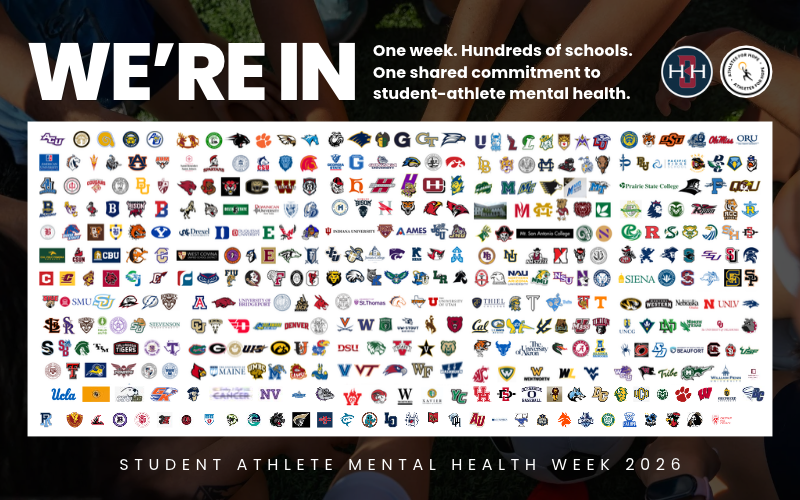
More than 572 schools signed up for SAMHW this year. That includes colleges, universities, high schools, and entire school districts in all 50 states, from Division I programs to community colleges.
The message spread just as far online. During the week of October 3–10, SAMHW content on Athletes for Hope’s social channels was seen more than 1.8 million times. On Instagram alone, it reached 977,000 accounts.
People didn’t just scroll past. They liked, commented on, shared, and saved our posts more than 50,000 times, and watched more than 119,000 minutes of video. That’s nearly 2,000 hours of athletes talking about mental health.
The number we’re proudest of is shares. On Instagram, shares jumped more than tenfold over the week before. Every share is an athlete, coach, or parent telling their own followers: this matters to me.
People came looking for more. During SAMHW week, 2,540 visitors viewed more than 4,700 pages on athletesforhope.org, and more than one in four of those views were mental health content. The AFH Center for Wellbeing drew 310 views, and readers spent an average of nearly five minutes with Beyond the Game: Protecting the Mental Health of Young Athletes.
What it looked like on the ground
Every school made the week its own. That has always been the point.
Green ribbons showed up on uniforms, in ponytails, and on sidelines. Athletes wore SAMHW bracelets, pins, and tattoos to practice and to games. Coaches wore them too.
At stadiums and courts across the country, teams honored Three in the Third. Tyler wore number 3, so during the first play of the third quarter, athletes, coaches, and fans raise three fingers to honor his life and keep spreading the message of SAMHW. Mental health PSAs played over the speakers. And teammates had conversations that might not have happened otherwise.
Every participating school received a free SAMHW box to make it easy to show up. Inside: bracelets, pins, ribbons, tattoos, stickers, and more, so a whole team could wear the week together.
Why we pushed into high schools
The pressure athletes face doesn’t start at 18. The high school years are when performance, identity, and expectations start to pile up, often before a young athlete has the support or the words to handle them.
That’s why AFH’s role this year was built to bring SAMHW beyond college campuses and into high schools and youth sports. Reaching athletes earlier means we’re not waiting for a crisis. We’re building a healthier culture from the start.
The question of who you are when the game ends is one every athlete eventually faces. We explored it in Athlete Displacement: Finding Identity Beyond the Game.
Athletes as messengers
When athletes talk openly about their mental health, they give teammates and the young people watching permission to do the same. That’s why athlete-led storytelling isn’t a nice-to-have. It’s how the culture changes.
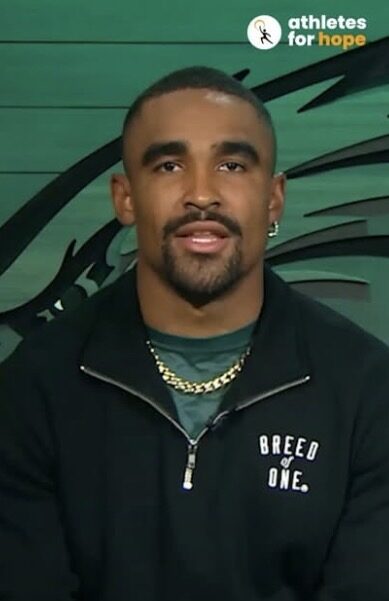
Jalen Hurts knows pressure. He was benched at halftime of a national championship game, in front of the whole country. He transferred, rebuilt, became a Heisman finalist, and went on to be named Super Bowl LIX MVP. For SAMHW, he shared a message for every student-athlete: taking care of your mind is part of taking care of your game, and asking for help is the kind of courage that builds champions. Watch Jalen’s message.
He wasn’t alone. Athletes at every level added their voices:
When a Super Bowl MVP and a college softball team say the same thing, athletes listen: you don’t have to go through it alone.
What AFH brought to the table
As Co-Presenting Partner, Athletes for Hope contributed:
- Athlete-led resources from the AFH Center for Wellbeing, built by athletes and supported by clinical expertise
- Ambassador storytelling from AFH’s national athlete community
- Campus activations through AFH University
- A panel on wellbeing in sport, “The Mental Health Science Athletes Aren’t Being Told,” featuring Dr. Pamela Collins of Johns Hopkins
- Youth programming through CHAMPS and AFH’s high school network
A week is a starting point
SAMHW works because it focuses the whole sports world’s attention on one message at the same time. But what it builds is meant to outlast October. Schools leave with resources, language, and a community that keeps showing up.
The SAMHW Toolkit stays live. The Center for Wellbeing stays open. The conversation doesn’t end on October 10.
Thank you to the 572+
To every school, athletic department, coach, clinician, and student-athlete who took part: you showed up. In a culture that still sometimes treats vulnerability as weakness, that matters.
To Kym, Mark, and the entire Hilinski’s Hope team: thank you for building something worth joining.
Tyler’s legacy lives in every green ribbon, every three fingers raised in the third quarter, and every conversation that happened this week that wouldn’t have before.
We’re just getting started.
Resources
Need support now? Call or text 988 to reach the 988 Suicide & Crisis Lifeline, free and available 24/7 in the U.S.
Frequently asked questions
What is Student-Athlete Mental Health Week? An annual week of collective action, led by Hilinski’s Hope, to break down mental health stigma and expand resources for student-athletes at colleges, universities, and high schools nationwide. 2026 marked the seventh year, and the first co-presented with Athletes for Hope.
When does it take place? SAMHW 2026 ran October 3–10, alongside Mental Illness Awareness Week, and ended on World Mental Health Day, October 10.
How can my school get involved next year? Visit hilinskishope.org/samhw to register and access the SAMHW Toolkit. Every participating school receives a free SAMHW box of pride items.
What does Athletes for Hope bring to the partnership? Athlete-led mental health resources, ambassador storytelling, campus activations through AFH University, and youth programming, all supported by the AFH Center for Wellbeing.