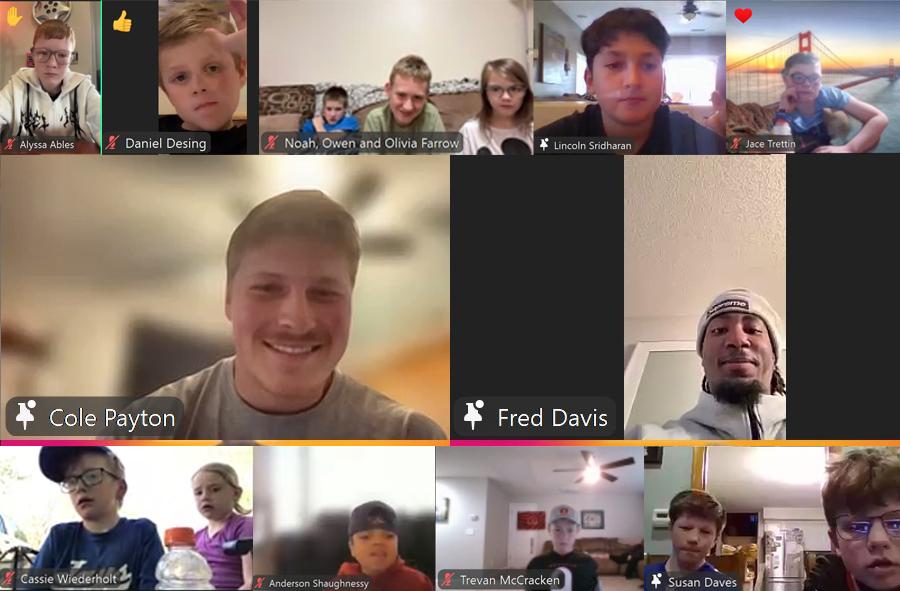

Twenty years in, we still believe athletes can change the world. But it starts closer to home than you might think.
At this year’s ESPYs, AFH Athlete Leadership Council member Stephen Curry took the stage to accept the Muhammad Ali Sports Humanitarian Award — an honor named for one of Athletes for Hope’s own founders — and said something that stopped us in our tracks.
“Don’t ever forget that you have a platform. You have a voice. You have everything that you need to make a true impact. And I encourage you to find your Oakland. Find what makes you different and where you can have that impact.”
Find your Oakland.
For Curry, Oakland isn’t just a city. It’s the place that shaped him, supported him, and — through the Eat. Learn. Play. Foundation — the community he’s poured himself back into. It’s where his giving has roots. And for most of us, that kind of clarity — knowing where you belong and who you’re showing up for — is harder to come by than it sounds.
The connection problem
We are, on paper, more connected than we’ve ever been. We have social media, we have group chats, we have comment sections and follower counts and a notification for everything. And yet.
According to the American Psychological Association’s 2025 Stress in America survey, more than six in ten U.S. adults reported feeling lonely, while roughly half said they felt isolated, left out, or lacking companionship often or some of the time. Nearly seven in ten said they needed more emotional support in the past year than they actually received. APAAPA
We’re scrolling through other people’s lives and still feeling alone in our own. The screen — whether it’s your phone, your work laptop, or your TV — was supposed to bring us closer. For a lot of people, it’s doing the opposite.
This is the world athletes are operating in. And it’s the world their communities are living in too.
What community actually means
Here’s the thing about community: it’s not automatic. Sharing a zip code with someone doesn’t make them your community. Having the same employer doesn’t either. Community is something you choose — and something you have to define before you can show up for it.
For athletes, that definition gets complicated fast. You might have grown up in one city, gotten drafted to another, and built a career in a third. Your fans live everywhere. Your teammates rotate. Where do you actually belong?
These are the questions worth sitting with:
Where did someone believe in you before you gave them a reason to? That place — whether it’s a high school gym in rural Georgia or a rec center in East Oakland — often holds more loyalty to you than you realize. It’s also where your presence means the most.
Where do you see a need you’re actually equipped to meet? Platform matters less than fit. The most lasting impact usually comes from people solving problems they understand personally — not just problems that make good press.
Where do you feel the pull to go back? If there’s a place you think about, talk about, or feel connected to even when you’re far away from it — that’s probably a signal worth paying attention to.
Who are the people you want to see win? Community isn’t just geography. It’s the group of people whose success feels personal to you. It might be kids who look like you did at twelve. It might be a neighborhood that’s being overlooked. It might be a cause you’ve lived through yourself.
None of these questions have one right answer. And for some athletes, the answer changes over time. That’s okay. The point isn’t to lock yourself into a place or a people forever — it’s to get honest about where your energy goes when it’s freely given.
Why it matters for you, not just them
We talk a lot about what athletes can do for their communities. We talk less about what community does for athletes.
Research consistently shows that people who give their time and skills to others experience lower rates of depression, anxiety, and loneliness, along with higher life satisfaction and self-esteem. Nurturing meaningful relationships and feeling a sense of connection has real physiological effects on physical and psychological health and resilience — possibly even strengthening the immune system and increasing longevity. University of Kentucky HRMental Health UK
Giving back isn’t a sacrifice. It’s one of the more reliable ways to feel like yourself.
Athletes already know this on some level. The locker room, the team bus, the shared grind of a season — those bonds are real, and they matter. Community work taps into the same instinct. You’re part of something bigger than your own stats. You’re accountable to people who need you. That sense of purpose is good for you, not just for them.
Twenty years of believing this
This year, Athletes for Hope turns 20. Two decades of working alongside athletes — from Olympic champions to first-generation college players — who decided their platform was worth using. What we’ve seen, over and over, is that the ones who build something lasting are the ones who did exactly what Curry described: they found their Oakland. They got specific. They got honest. And then they showed up, consistently, for the people they chose.
We’re still here because we believe that athletes have a unique ability to inspire action, connect communities, and model what it looks like to give a damn. But that belief only means something when it’s grounded — in a real place, real people, real need.
Twenty years in, the question is the same as it’s always been: What’s yours?
Join us in celebrating 20 years of athletes making the world a better place — and learn how you can be part of what’s next: athletesforhope.org/20.